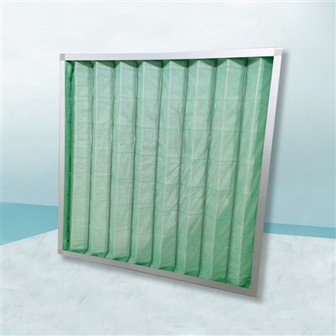
Filtration Principle of Primary Bag Filter


As the first filtration barrier of air purification systems, the Primary Bag Filter is widely used in fresh air systems, central air conditioners and industrial ventilation equipment. It mainly captures coarse pollutants including hair, poplar catkins, dust and fibrous particles larger than 5 μm. Its filtration process does not rely on screening alone; instead, it is driven by the combined effect of multiple physical mechanisms: inertial impaction, direct interception, diffusion adsorption and electrostatic adsorption, delivering stable and efficient filtration performance.
First, inertial impaction is the core mechanism for capturing large particles. As dust-laden air flows rapidly into filter bags, airflow continuously changes direction through gaps between filter media fibers. Heavy contaminants such as dust particles and hair lack the ability to follow abrupt airflow shifts due to inertia. They collide directly with filter bag fibers, become trapped and separated from the airstream. The larger the particle size and the higher the air velocity, the more prominent the inertial impaction effect.
Next, direct interception targets medium-sized particles. Filter bags are constructed from tightly woven chemical fiber filter media with uniform micro-pores formed between fibers. When airflow transports dust particles slightly smaller than these pores, particles move close to fiber surfaces and become blocked by fiber pores. Compared with standard panel filters, bag-type filters offer a larger unfolded surface area with evenly distributed pores and a wider interception range, effectively preventing particle penetration through filter layers.
Diffusion and electrostatic adsorption capture ultrafine particles. Tiny dust particles undergo irregular Brownian motion and make sufficient contact with filter media fibers during diffusion before being adsorbed. Meanwhile, conventional primary filter media carry trace static electricity, which actively attracts suspended fine particles and greatly improves filtration efficiency. With the synergy of multiple mechanisms, the filter achieves effective pre-purification, prevents large particles from entering downstream pipelines and precision filtration equipment, reduces loads on subsequent equipment and extends the service life of the entire purification system.
In summary, the Primary Bag Filter operates through the coordinated action of the physical filtration mechanisms outlined above. The expanded bag structure increases filtration area and lowers air resistance, while layered filter media enable graded dust interception. It first intercepts large debris and then captures medium and small suspended dust to complete rough pre-purification of intake air. This effectively extends the service life of downstream medium-efficiency and high-efficiency filters. It is extensively applied in factory ventilation, central air conditioning, pre-filtration for clean workshops and other scenarios.