

What size particles can a Cleanroom HEPA Filter capture?
Hey there! As a supplier of Cleanroom HEPA Filters, I often get asked about what size particles these filters can capture. So, I thought I'd dive into this topic and share some insights with you.
First off, let's talk about what a Cleanroom HEPA Filter is. A Cleanroom HEPA Filter is a high - performance air filter that's used in cleanrooms. Cleanrooms are spaces where the concentration of airborne particles is controlled to very low levels. These filters play a crucial role in maintaining the air quality in environments like pharmaceutical manufacturing plants, semiconductor fabrication facilities, and research laboratories.
Now, to understand the particle - capturing capabilities of a Cleanroom HEPA Filter, we need to know about the concept of particle size. Particles in the air come in all sorts of sizes, ranging from extremely tiny to relatively large. The size of a particle is usually measured in micrometers (μm), where 1 micrometer is one - millionth of a meter.
HEPA stands for High - Efficiency Particulate Air. A standard Cleanroom HEPA Filter is designed to capture at least 99.97% of particles that are 0.3 micrometers in size. You might be wondering, why 0.3 micrometers? Well, particles of this size are considered the "most penetrating particle size" (MPPS). This means that particles around 0.3 micrometers are the hardest to capture compared to larger or smaller particles.
Let's break down how a Cleanroom HEPA Filter captures particles of different sizes.

Capturing Larger Particles
For particles larger than 0.3 micrometers, the capture mechanism is mainly based on impaction and interception. When air flows through the filter, larger particles are too big to follow the air streamlines around the filter fibers. Instead, they collide with the fibers (impaction) and get stuck. Interception also plays a role, where particles that come close enough to the fibers while following the air flow are captured by the fibers' surface forces.
For example, dust mites, pollen, and some types of mold spores are relatively large particles. Dust mites can be around 100 - 500 micrometers in size, and pollen grains can range from 10 - 100 micrometers. A Cleanroom HEPA Filter can easily capture these larger particles, ensuring that they don't circulate in the cleanroom environment.
Capturing Smaller Particles
When it comes to particles smaller than 0.3 micrometers, the main capture mechanism is diffusion. Small particles are constantly in motion due to Brownian motion, which is the random movement of particles in a fluid (in this case, air). As these tiny particles move around, they are more likely to come into contact with the filter fibers and get captured.
Viruses, for instance, are extremely small particles. Most viruses range from about 0.02 - 0.3 micrometers in size. A Cleanroom HEPA Filter can effectively capture a significant portion of these small particles, helping to prevent the spread of airborne diseases in cleanroom settings.
The 0.3 - Micrometer Challenge
As I mentioned earlier, 0.3 - micrometer particles are the most difficult to capture. These particles are small enough to follow the air streamlines around the filter fibers, but too large to be easily captured by diffusion. However, the design of a Cleanroom HEPA Filter is optimized to overcome this challenge. The filter media is made up of a dense web of fine fibers that create a tortuous path for the air to flow through. This increases the chances of 0.3 - micrometer particles colliding with the fibers and getting captured.
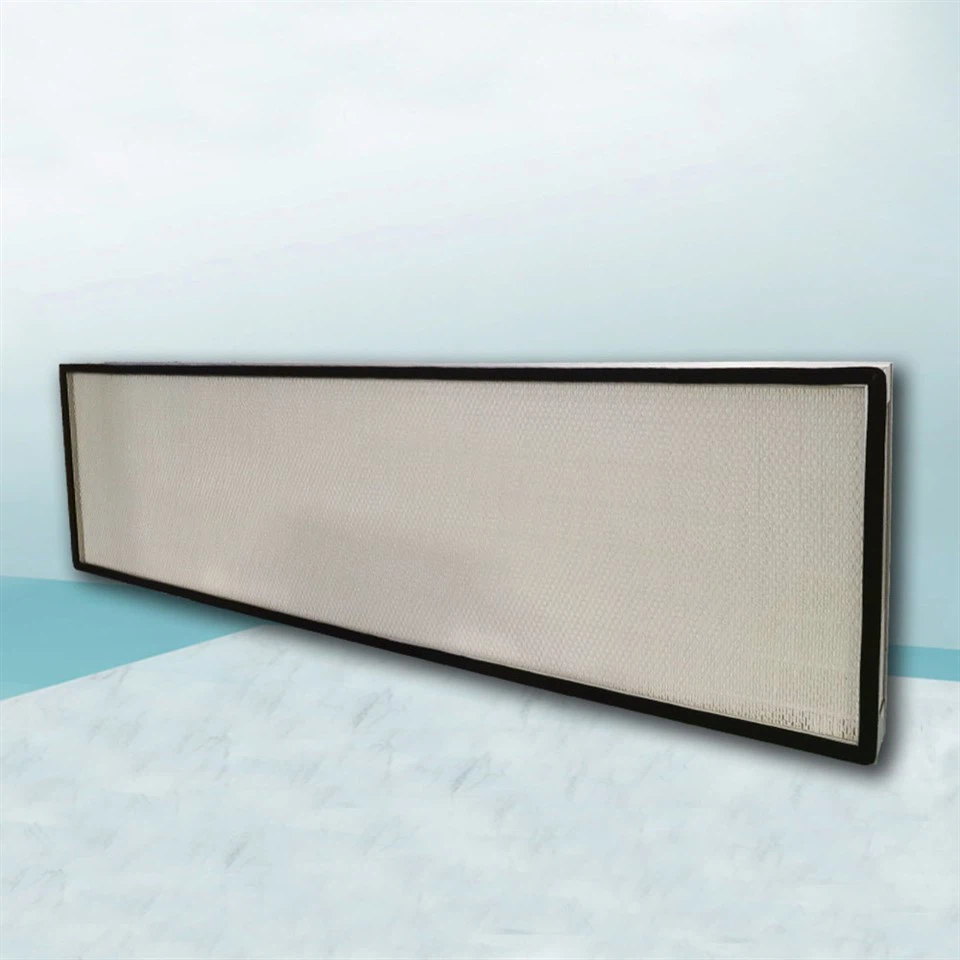
Now, let's talk about the different types of Cleanroom HEPA Filters that we offer. One of our popular products is the Aluminum Frame No Partition Filter. This filter has an aluminum frame, which provides good structural support. The no - partition design allows for a larger filter area, which in turn increases the filter's efficiency and lifespan.
Another great option is our High Efficiency Air Filter. This filter is designed to provide high - performance air filtration in cleanroom environments. It's made with high - quality filter media that can effectively capture particles of various sizes, meeting the strict requirements of cleanroom applications.
So, if you're in the market for a Cleanroom HEPA Filter, it's important to consider your specific needs. Think about the types of particles that are present in your cleanroom environment, the required air flow rate, and the level of air cleanliness you need to maintain.
If you're looking for a reliable Cleanroom HEPA Filter supplier, look no further. We've got a wide range of filters to suit different applications and budgets. Whether you're running a small research lab or a large - scale manufacturing facility, we can help you find the right filter for your needs.
If you're interested in our products and want to learn more or start a procurement discussion, don't hesitate to reach out. We're here to answer your questions, provide technical support, and help you make the best decision for your cleanroom air filtration requirements.
References
- "Fundamentals of Air Filtration" by Klaus Willeke and Philip A. Baron
- "Cleanroom Technology: Fundamentals and Applications" by Peter A. Revesz