

What is the quality control process for industrial HEPA filters?
As a supplier of Industrial HEPA filters, I understand the criticality of quality control in ensuring that our products meet the highest standards and provide optimum performance in various industrial applications. In this blog post, I will delve into the quality control process for industrial HEPA filters, shedding light on the steps we take to deliver reliable and efficient filtration solutions.
Raw Material Inspection
The quality control process for industrial HEPA filters begins with a meticulous inspection of raw materials. We source high - quality materials, including filter media, frames, and seals, from trusted suppliers. The filter media is the heart of the HEPA filter, and its quality directly affects the filtration efficiency.
We conduct in - depth testing on the filter media to assess its fiber composition, porosity, and thickness. This ensures that it has the appropriate density and structure to capture particles effectively. For example, we use advanced microscopy techniques to examine the microscopic structure of the fibers in the media. Any deviation from the specified parameters can lead to inconsistent filtration performance, so strict adherence to quality standards is crucial.
The frames, which can be made of materials like aluminum or steel, are inspected for their dimensional accuracy, strength, and surface finish. A well - constructed frame provides mechanical support to the filter media and ensures a proper fit in the filtration system. The seals, usually made of rubber or foam, are checked for their elasticity, chemical resistance, and ability to prevent air leakage. Defective materials are immediately rejected, preventing any potential issues from moving further down the production line.
In - process Quality Checks
During the manufacturing process of industrial HEPA filters, numerous in - process quality checks are carried out to monitor the production steps and ensure that the filters are being assembled correctly. Workers are trained to follow strict assembly procedures, and each stage of the manufacturing process is carefully supervised.
For instance, when the filter media is being pleated, the pleat height, pleat spacing, and pleat uniformity are continuously measured and adjusted. Proper pleating is essential as it maximizes the surface area of the filter media, allowing for more efficient particle capture. Automated sensors are often used to detect any irregularities in the pleating process, and if a problem is detected, the production line can be stopped immediately for corrective action.
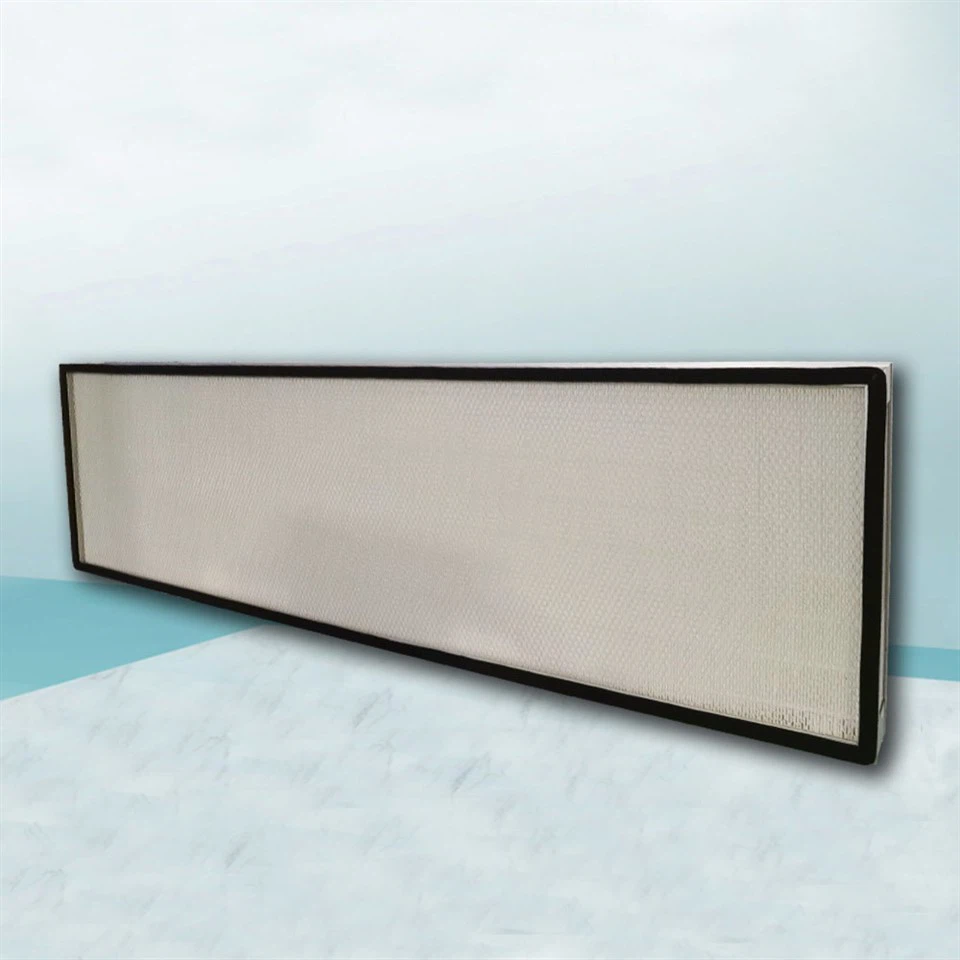

In the case of frame assembly, the alignment of the frame components and the secure attachment of the filter media to the frame are verified. Precise alignment is necessary to prevent air bypass, which can significantly reduce the filter's efficiency. Any scratches, dents, or misalignments on the frame are also identified and rectified during this stage.
Performance Testing
Once the industrial HEPA filters are assembled, they undergo comprehensive performance testing to ensure that they meet the specified efficiency and airflow requirements. One of the most important tests is the particle counting test. This test measures the percentage of particles removed by the filter at different particle sizes.
We use state - of - the - art particle counters to introduce a controlled flow of particles of various sizes (usually in the range of 0.1 - 5 microns) through the filter. The number of particles upstream and downstream of the filter is then measured. A high - quality HEPA filter should be able to capture at least 99.97% of particles with a diameter of 0.3 microns. Filters that do not meet this efficiency standard are removed from the production batch for further inspection or rework.
In addition to particle counting, airflow testing is also conducted. The filter's resistance to airflow, also known as its pressure drop, is measured. This is an important parameter as it affects the energy consumption of the filtration system. A filter with a high pressure drop will require more energy to operate, increasing operational costs. We ensure that our filters have an acceptable pressure drop within the industry - recommended range.
Leak Testing
Leak testing is another crucial step in the quality control process for industrial HEPA filters. Even a small leak in the filter can allow unfiltered air to pass through, compromising the overall filtration efficiency. Two common methods of leak testing are the DOP (Dioctyl Phthalate) test and the PAO (Poly - Alpha - Olefin) test.
In these tests, a challenge aerosol is introduced upstream of the filter. A scanning probe is then used to detect any leaks around the edges of the filter, the seal areas, and through the filter media. If a leak is detected, the location is marked, and the filter is either repaired or discarded, depending on the severity of the leak.
Final Visual Inspection
Before the industrial HEPA filters are packaged and shipped out, a final visual inspection is conducted. This is a last - chance check to ensure that the filters are free from any cosmetic defects, such as scratches, stains, or loose parts. The labels on the filters are also verified to ensure that they contain accurate information about the filter's specifications, such as its efficiency rating, size, and recommended operating conditions.
Product Traceability
In our quality control process, we also place a strong emphasis on product traceability. Each industrial HEPA filter is assigned a unique identification number, which allows us to track its entire production history, from the raw material sourcing to the final testing results. This enables us to quickly identify and address any quality issues that may arise after the product has been delivered.
Our Product Offerings and Related Links
We offer a wide range of industrial HEPA filters, including No Partition Air Filter, Aluminum Frame No Partition Filter, and No Partition High Efficiency Filter. These filters are designed to meet the diverse needs of different industrial applications.
Conclusion
Quality control is an integral part of our operations as an industrial HEPA filter supplier. By implementing a rigorous quality control process, from raw material inspection to final visual assessment, we ensure that our filters provide reliable and efficient performance. Our commitment to quality helps our customers maintain a clean and safe working environment, while also reducing operational costs associated with filtration systems.
If you are in the market for high - quality industrial HEPA filters, we invite you to contact us for a detailed discussion about your specific requirements. Our team of experts is ready to assist you in finding the best filtration solutions for your application.
References
- "High - Efficiency Particulate Air (HEPA) Filters: A Technical Overview", Filtration Industry Association.
- "Quality Control in Manufacturing of Air Filtration Products", Journal of Industrial Filtration and Separation.