


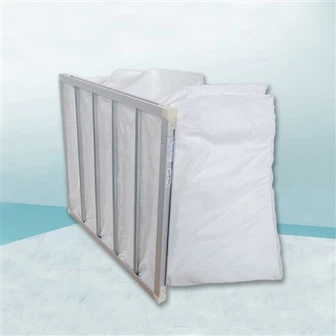
Primary Pocket Filter
Primary Pocket Filter features a larger filtration area and higher dust holding capacity than flat primary filters, resisting premature clogging. The gradient filter media improves particle capture efficiency and maintains stable airflow within ventilation systems. As the frontline dust barrier, it slows contamination of medium and high-efficiency filters and extends the service life of premium filter materials. It allows flexible installation and enables quick inspection and replacement. Constructed from flexible material, it resists cracking and damage under normal operating conditions. Balancing filtration performance and cost-effectiveness, it effectively cuts long-term operation expenses for the entire air handling system.
Product Introduction
Products Description
Primary Pocket Filter consists of bag-shaped filter bodies sewn from multi-layer composite synthetic fiber media and assembled with galvanized metal frames. It serves as the first-stage filtration device in air purification systems. The filter media adopts a gradient structure from loose to dense, effectively intercepting dust, flying lint, debris and other large particulate pollutants. The equipment delivers smooth airflow with low initial resistance and moderate pressure rise as dust accumulates. It is applicable to central air conditioning, industrial exhaust, fresh air purification and other scenarios, blocking impurities from entering downstream filtration equipment. Some filter pockets are washable for repeated use, bringing moderate overall operating costs. Lightweight and easy to disassemble and maintain, it acts as an essential front protection device for ventilation systems in buildings and factories.
Manufacturing Technology
Thermal Bonding
Primary Pocket Filter adopts seamless thermal bonding technology. Without gaps created by traditional stitching, it prevents impurities from leaking through seams and compromising filtration performance.
Gradient Filter Layer
The filter media features a density gradient design from outer to inner layers, intercepting contaminants step by step and greatly boosting overall dust holding capacity.


Internal Support Frame
Rigid supporting structures are installed inside each pocket to prevent deformation and damage under high airflow pressure and extend service life.
Surface Anti-Corrosion Treatment
The housing undergoes special anti-rust and anti-corrosion treatment to support long-term operation in conventional humid and mildly corrosive environments.
Operation Instructions
Inspection after Unpacking
Check the housing, filter pockets and sealing components after unpacking. Proceed with installation only after confirming no transportation damage.
01
Proper Pocket Installation
Clean the internal cavity before installation. Fully fit the matching sealing gaskets into clamping grooves to avoid air leakage through gaps.
02
Gradual Valve Opening
Open valves slowly during startup. Prevent instant high airflow from directly impacting filter pockets and causing accidental damage.
03
Regular Inspection
Check sealing conditions at equipment connections during operation. Shut down the unit promptly for troubleshooting if leakage occurs.
04
Drainage before Long Shutdown
Drain residual fluid inside the cavity before prolonged shutdown to prevent accumulated contaminants from drying out and clogging pockets and pipelines.
05
Precautions
Do not operate Primary Pocket Filter continuously beyond its applicable temperature and pressure limits, which may lead to housing deformation, pocket rupture and contaminant bypass.
The standard model without special customization shall not be directly exposed to highly corrosive fluid to avoid rapid corrosion of the housing and filter media.
Keep sharp objects away during storage and operation to prevent tearing filter pockets and scratching the anti-corrosion coating on the housing.
Vent the cavity with low flow rate before gradually increasing flow upon startup to avoid pressure buildup inside the housing and sealing failure.
Application Image


FAQ
Q: How frequently should Primary Pocket Filter be cleaned on average?
A: The cleaning interval depends mainly on dust concentration on site. Cleaning can be scheduled less frequently in low-dust environments, while shorter cycles are required for heavily dusty conditions. Observe airflow volume during operation. Obvious airflow reduction indicates heavy dust accumulation on pockets, calling for timely cleaning. Proper maintenance ensures stable ventilation performance.
Q: Will washing degrade the filtration performance of pocket filters significantly?
A: Filter pockets can maintain basic filtration capacity if gently cleaned and fully air-dried. However, repeated washing gradually alters the fiber structure and weakens filtration efficiency. Replace the filter after a certain service period to guarantee stable air purification results.
Q: What causes unpleasant odors when Primary Pocket Filter is running?
A: Odors are mostly generated by microbes breeding on dust and moisture trapped in filter pockets. Humid environments aggravate this issue. Maintain dry ventilation and clean pockets regularly to avoid long-term contaminant adhesion and reduce odor formation.
Production Equipment


Hot Tags: primary pocket filter, China primary pocket filter manufacturers, suppliers, factory, cotton air filter, handheld air filter, indoor air filter, outdoor air filter, public place air filter, workspace air filtration system
You Might Also Like




Send Inquiry
